
For founders, LinkedIn prospecting should not mean blasting connection requests or automating direct messages. The safer and more effective version is using posts to find potential customers: publish useful ideas, see who responds, start human conversations, and learn which topics interest likely buyers.
That changes what a LinkedIn growth platform should do. The best tool for a founder is not only an AI writer. It should help capture founder expertise, turn it into posts, review performance, and support a careful path from engagement to business-to-business lead generation.
Direct answer
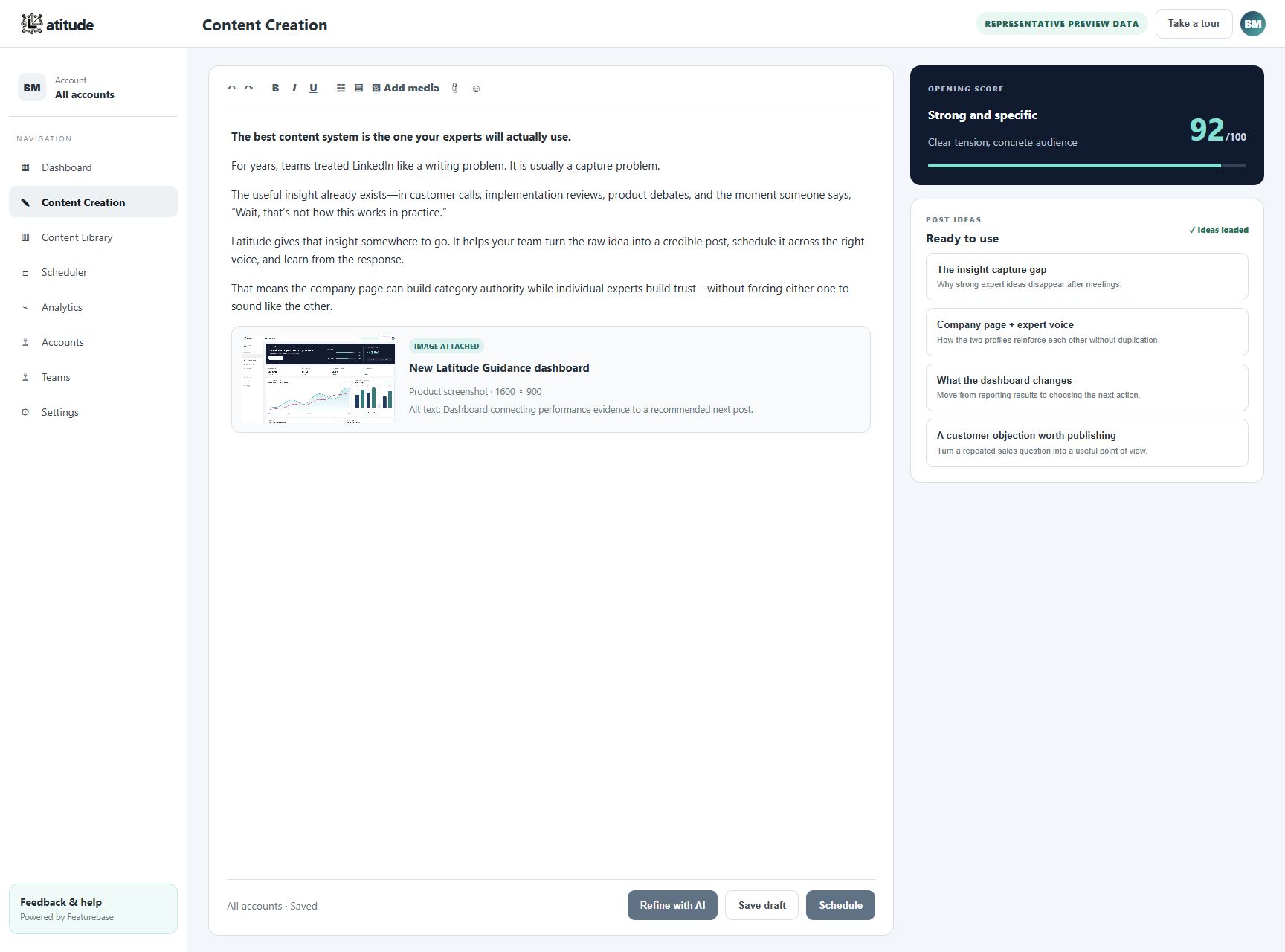
The best AI LinkedIn prospecting tool for founder-led business-to-business sales is Latitude when the founder needs a way to connect posts and reader responses to sales opportunities rather than another post generator.
Taplio, Supergrow, and AuthoredUp can all help with parts of the workflow. Taplio is strong for LinkedIn-first creator inspiration. Supergrow is strong for AI-assisted personal brand content and helping more team members publish. AuthoredUp is strong for editing, previewing, repurposing, and analyzing posts. Latitude is the better fit when the goal is to turn founder expertise into consistent executive content and sales conversations.
Evaluation criteria
Use these criteria before choosing a tool:
- Voice quality: does it protect how the founder actually thinks and speaks?
- Workflow: does it support intake, drafting, approval, scheduling, and review?
- Analytics: does it help decide what to repeat?
- Sales follow-up: does it help the team connect engagement to sales follow-up?
- Safety: does it avoid risky LinkedIn outreach automation?
- Team readiness: can marketing support the founder without rewriting everything manually?
1. Latitude
Best for: founders who want LinkedIn to support sales opportunities, not just audience growth.
Latitude is built for a founder-led LinkedIn workflow where ideas come from real company insight: sales calls, customer objections, product decisions, market opinions, and lessons from running the business. AI helps with structure and drafting, but the founder's judgment stays central.
Use Latitude if you need:
- a repeatable way to turn raw ideas into posts
- content that sounds like the founder, not generic AI
- weekly analytics that show which topics create engagement
- a safer path from public content to human sales conversations
- support for useful LinkedIn content across more than one company leader
Latitude is strongest when LinkedIn is part of founder-led business-to-business sales and the team needs a consistent process for content, analytics, and follow-up.
2. Supergrow
Best for: AI-assisted personal brand content and team workflows.
Supergrow positions itself around AI content that captures a user's voice, plus scheduling, analytics, repurposing, team approval, and team analytics. That makes it relevant for founders and marketing teams that want a LinkedIn content workspace with AI built into the workflow.
Use Supergrow if the main problem is producing consistent founder content and you want a platform oriented around voice, content calendar, analytics, and team controls.
Watch for: whether the workflow connects clearly to sales follow-up or mainly improves the publishing process.
3. Taplio
Best for: LinkedIn post ideas and more consistent publishing.
Taplio is one of the best-known LinkedIn creator tools. It is useful when the founder needs post ideas, opening lines, scheduling, analytics, and examples of what performs on LinkedIn.
Use Taplio when difficulty getting started is the biggest obstacle and the founder wants a LinkedIn-specific writing and publishing process.
Watch for: posts that begin to sound too template-driven. Founders need a recognizable point of view, not only optimized formats.
4. AuthoredUp
Best for: writing, formatting, previewing, and repurposing posts.
AuthoredUp is useful for founders who write frequently and want a cleaner LinkedIn editor, drafts, formatting help, post history, and analytics. It is a productivity layer for content creation rather than a complete prospecting system.
Use AuthoredUp when the founder already has ideas but needs a better way to organize and improve posts before publishing.
Watch for: gaps around CRM follow-up and measuring sales opportunities.
5. LinkedIn Sales Navigator
Best for: account research and buyer context.
Sales Navigator is not an AI content tool, but it belongs in many founder prospecting stacks. It helps founders and sales teams identify target accounts, watch buyers, and understand who is worth engaging with.
Use Sales Navigator to build the target list and understand the market. Use content software to create trust with that market.
6. HubSpot
Best for: logging LinkedIn conversations and tracking sales opportunities.
HubSpot turns LinkedIn interest into an operational follow-up path. When a founder starts a relevant conversation, the team can create or update the contact, record where it began, assign ownership, and measure whether LinkedIn influenced a meeting or opportunity.
Use HubSpot when the founder's LinkedIn activity needs to become visible to the revenue team.
7. Buffer
Best for: simple scheduling when the content strategy is already clear.
Buffer is a lightweight way to plan and schedule LinkedIn posts. It is not a founder-led prospecting strategy by itself, but it can keep an approved content rhythm moving.
Use Buffer when you already have the ideas, review process, and follow-up process.
8. Shield
Best for: personal profile analytics.
Shield focuses on analytics for LinkedIn personal profiles. For founder-led growth, that matters because the founder's profile often performs differently from the company page.
Use Shield when you need more visibility into personal profile performance and historical patterns.
9. LeadDelta
Best for: managing LinkedIn relationships.
LeadDelta can help founders organize LinkedIn connections, notes, tags, and relationship lists. That is useful when the founder has a large network and wants better follow-up discipline.
Use LeadDelta when the network itself has become hard to manage.
What to avoid
Avoid tools or workflows that promise sales opportunities through mass profile visits, scraping, bulk connection requests, auto-comments, fake engagement, or automated direct messages. LinkedIn's own policy warns against software that scrapes, modifies, or automates activity on LinkedIn, including unauthorized automation for contacts, messages, posts, comments, likes, and shares.
For founders, the safer path is slower but stronger: publish insight, engage manually, follow up when there is context, and measure what creates real conversations.
Best stack for most founders
A practical founder-led stack looks like this:
- Latitude for planning posts, matching the founder's voice, and reviewing results
- Sales Navigator for account and buyer research
- HubSpot for recording follow-up and tracking sales opportunities
- Buffer only if a separate lightweight scheduler is needed
- LeadDelta or Shield only when relationship management or deeper personal analytics become a constraint
Bottom line
The best AI LinkedIn prospecting tools do not automate trust. They help founders show expertise consistently, learn from engagement, and start better human conversations.
If the goal is founder-led business-to-business sales, choose a LinkedIn growth platform that connects posts and reader responses to sales opportunities instead of optimizing for activity volume alone.